
The Freightor Fantastico
In the early hours of Saturday, March 13, 1993 a Spring storm of tremendous strength crashed into Florida’s West Coast.
Labeled the “No Name Storm” it brought with it near hurricane force winds and tidal surges as high as 12 feet. The storm caused more than $500 million dollars in damages to properties along Florida’s Gulf Coast and killed at least 26 people.
That same Saturday morning the 200 foot Honduran freighter Fantastico was chugging through the gulf bound for Tampa with a full load of phosphate. While rough seas had been forecast, the strength of the storm had been
grossly underestimated, and just after dawn, the crew of the Fantastico found themselves floundering in 30 foot waves and winds over 70 miles per hour. Not long after, approximately 57 miles Northwest of Naples, Florida, the
Fantastico succumbed to the wicked conditions and sank.
Of the ten men who crewed her, three were rescued by the Coast Guard as they clung to an overturned lifeboat, three bodies were later recovered, and four were never found.
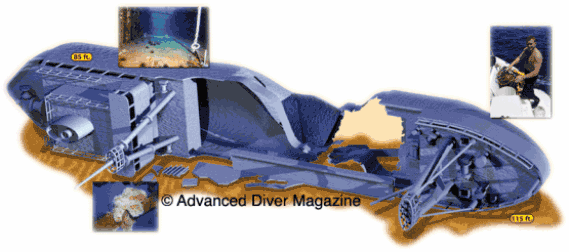
Fantastico now rests in the sand of the Gulf of Mexico in 115 feet of water with the top of the wreck coming up to 80 feet. When first dove in 1994, she was found lying on her starboard side with the bow pointing
north. Oil was still seeping from the wreck and her booms and masks were still rigged and steel cable.
Four inch manila line floated torward the surface and clouds of shimmering baitfish darted all over her. The anchor was still housed and at the stern, schools of snapper swam around the single propeller. Her pilothouse and machinery rooms were accessible. A stretcher and first aid kit were found lying in the sand nearby. The ship’s load line certificate, issued July 13, 1992, was found in the pilothouse. The only evidence of damage was a crack in the steel hull that ran on the port side from the main deck to the keel. A few barracudas circled high above the wreck and the name Fantastico was still clearly made out, painted in bold black letters on the ship’s port bow.
Dives in 1995 and 1996 disclosed an ever-increasing colonization by marine life. Sea urchins and small soft corals were attached to the length of the hull. Schools of amberjack and spadefish swam around the wreck in
large numbers, inquisitively checking out divers. A nurse shark slept on the bottom inside the cargo hold. Free swimming blacktip and bull sharks circled at distances of 30 to 40 feet, and the first three of four jewfish were
spotted.
Dives to the wreck in September of 1997 saw cobia, Spanish Mackeral, permit, and several more jewfish. The most dramatic observation of this trip was the collapse of the Fantastico’s cargo hold.
The crack observed earlier had pulled apart. A trip in 1998 was met with bad visibility, but even in poor conditions an increased collapse was evident. The resident jewfish population was also observed and growing larger at this time.
On Sunday, August 29, 1999, as Hurricane Dennis threatened the Eastern United States, Advanced Diver Magazine’s Dive Team visited the Fantastico to see what changes had occurred in the past year. The cargo area was found flattened and twisted. The port bow was still intact and the anchor remained housed in the hawse pipe. Port and starboard running lights were found hanging in the anchor locker. Manila line was coiled in the chain locker. The propeller was still in position, however the stern seemed to be twisted away from the bow section and had moved more to the starboard.
A commercial fishing net lay over a portion of the wreck with its large lead sinkers still attached. A porthole with glass intact was found attached to a wooden door in one of the many machinery spaces.
Monofilament fishing lines are now on much of the wreck, presenting a real entanglement hazard for divers. A pair of African pompano with long streamer fins gliding behind them were viewed cruising the area. Schools of amberjack and barracudes circled the waters overhead. Large, black grouper were seen hiding beneath metal sheets on the bottom, but the most prominent of all species viewed on the wreck were the jewfish, formally known as Epinephelus Itajara. Over forty were counted on this trip to the Fantastico.
These giants of the deep are the largest members in the grouper family attaining lengths to eight feet and weighing up to 700 pounds. They are indigenous to tropical waters throughout the Southern US and Carribbean, but
the largest concentrations of Jewfish are found on Florida’s Southwest coast from Sarasota to Naples. Jewfish were once prized by fisherman because of their tender, whit meat, but were hunted to near extinction in the
1980’s and in 1987 were granted protected status under the Endangered Species Act.
In the past few years, the results from this legislation have proved to be a major success, and with the greater number of divers in the water today, encounters with jewfish are becoming commonplace. While jewfish will take up residence on natural limestone or rock bottom, their lairs are shipwrecks, and their increased numbers have presented wreck divers with the interesting dilemma of how best to deal with them.
These “gentle giants” are normally docile creatures, but they can be unpredictable and extreme caution should be taken when encountering multiple large jewfish. They can become very aggressive if provoked,
cornered, or presented with freshly speared fish. When agitated, a jewfish will produce a loud, thunderous booming noise to warn potential predators or unweary divers of their displeasure. If they continue to feel
threatened, jewfish have been known to charge divers with incredibly quick bursts of speed. The skin of the jewfish is very rough, like sandpaper, and can cause serious injury just by rubbing against the diver.
The best device is to slowly swim away from their immediate vicinity. Usually if you leave them alone, they will do the same.
It was a breathtaking sight upon descending onto the Fantastico and seeing so
many jewfish. They hung together in tight schools and became visibly agitated and territorial as the dive team moved in. While we attempted to keep our distance, several large fish became curious and followed us along the
entire length of the ship. Two jewfish even followed some of the divers into the wreck when they penetrated the pilot house. This could easily of become an emergency situation if the large fish felt cornered, but patience and gentle movements on the divers part helped the team avoid any dangerous encounters.
On the trip back to the dock we discussed the significant changes that had taken place on the Fantastico. It was amazing how much structural deterioration the wreck had sustained in the short eight years since its
sinking, but dominating the conversation, and our memories of the trip were the jewfish. Their presence on the Fantastico had produced an unexpected and breathtaking excitement that few fish can match.
Dive team:
Curt Bowen, Dawson Cochran, Rusty Farst, Leroy McNeal, James Rozzi,
Kevin Sweeney, Jim Webber.
Sponsor:
The trip to the Fantastico was sponsored by:
Kevin Sweeney’s SCUBAdventures, L.C.
971 Creech Road, Naples, Florida (941) 434-7477
Kevin Sweeney’s
SCUBAdventures, L.C.
971 Creech Road
Naples, Florida 34103
Phone: 941-434-7477
| Intro | Home | Info | Scuba Training | Class Schedule | Local Diving | Rentals |
Services | Links | Calendar | Photo Gallery | Newsletter | Club Scuba | Email |
Copyright 1974-2001 Scubadventures L.C.
All Rights Reserved